
Communication is the outcome, not the device.
Communication used to be simple. Now it’s a barrier.
THE PROBLEM
Most people assume communication still means making a phone call.
They look at a handset, hear a dial tone, and think:
“He’s connected. She’ll be fine. They can call if they need help.”
But look closer at almost any home today:
• NBN connection dependent on electricity
• VoIP phones that go dead in a blackout (all landline are VoIP)
• iPads and Phones can be too old to run MyGov or Medicare
• Banking apps required — but unsupported on old phones
• Government portals demanding verification codes
• Identity checks people don’t know how to complete
• Online-only forms replacing face-to-face services
A person may be able to call —
but they cannot complete anything.
Communication hasn’t failed at the voice.
It has failed at the outcome.
And when communication fails today, the consequences are real.
A client can ring Centrelink (hour wait) —
but can’t verify through the app.
The call goes nowhere.
They can dial a bank —
but the branch is closed,
they need digital banking to buy food,
and their phone is too old to run it.
They want to book transport —
but the service only accepts digital requests.
They try to access MyGov —
but software is outdated, passwords forgotten,
two-factor codes never arrive,
and anxiety takes over.
The device works.
The task does not.
And in that moment, independence collapses.
Not because of ability —
but because communication is now multi-step, multi-system, multi-skill.
The industry moved.
The definition didn’t.
Vulnerable people were left behind.
SOLUTION
That’s where I step in.
Communication is the outcome — not the device.
My work is not to make phones ring.
It’s to make sure the result happens.
I build and maintain communication pathways so vulnerable people can:
• verify identity
• access MyGov and Medicare
• use digital banking to buy food
• submit forms, request services, book transport
• communicate with support workers and family
• ask for help and receive it
• complete the task — not just start it
I don’t install technology.
I restore access.
I prevent silent communication breakdown by:
• performing system health checks
• maintaining logins, passwords, accounts
• updating devices and apps
• building fail-safes and backups
• ensuring communication still works tomorrow
• protecting independence long-term
My goal is simple:
Communication must work when it’s needed — not when it’s convenient.
WHY I DO IT
I worked inside major telcos when this shift began.
I saw homes where everything looked connected,
yet nothing could be completed.
And I realised:
Devices weren’t failing.
Support systems were.
No one was bridging the gap.
So I built a role that does.
If you’re reading this, you already understand the stakes.
Communication is not a phone call.
It is everything required to complete the task.
And I help make sure that happens every time.
Next Step
If you support someone who needs communication reliability — real reliability —
you don’t need a device specialist.
You need an outcome specialist.
Reach out.
We can make communication work.
Timeline: How Communication Changed in Australia
From dial tone → to digital identity → to outcome-dependent access
1. Before 2013 – Phone Calls Were Communication
Single step = call → result
• Banks, Medicare, Centrelink all handled tasks over the phone
• No passwords, no accounts, no verification apps
• Communication = speaking to a person
• Vulnerable people could always communicate
(Phone alone was enough)
2. 2013 – myGov launches
[ANAO Audit Report]
• Services begin linking into a central portal
• Login required → first dependency step
• Beginning of self-service culture
• Phone starts losing authority
Communication now requires account access
3. 2014–2019 – Rapid shift to self-service digital portals
• Tax, Centrelink, Medicare, Child Support all moved online
• Fewer tasks completed over the phone
• More forms moved to web-only submission
• Help centres shifted toward “do it online instead”
Communication = device + skill + internet
4. 2020 – Mandatory 2FA for telco number transfers
[ACMA / Auth0 reference]
• Identity verification becomes required for basic communication tasks
• One step becomes several: Login → Code → Confirm → Outcome
Communication is no longer verbal — it’s procedural
5. 2022 – myGov official smartphone app released
Mobile-first access to Medicare, Centrelink, ATO
• Device + app + account required
• Digital identity becomes key to access
• No compatible phone = no access to services
Communication = device + identity pipeline
6. Nov 2024 – myGovID renamed myID (Digital Identity upgrade)
• Identity becomes a core requirement for government service access
• The person must authenticate → not just speak
• Completion relies on device + updates + codes + accounts
Communication = workflow, not dial tone
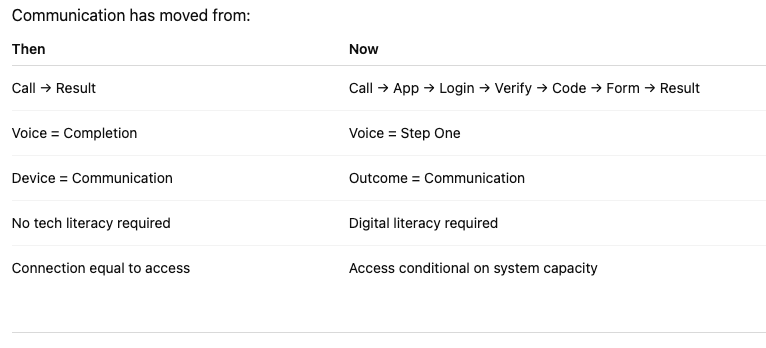
The pattern is clear
Start Here — The $47 Practical Blog
If you want a clear, real-world explanation of how modern communication support actually works — without theory, fluff, or sales padding — this is the place to start.
This $47 guide breaks down:
what has changed in everyday communication
why people now get stuck, overwhelmed, or locked out of essential services
and how simple, structured setups restore independence and reduce daily stress
It is written for carers, support workers, and coordinators who need practical clarity, not IT jargon.
All my work in the last 5 years I have created a what works blog.
Low cost. High signal. Immediate use.
Click below to access the full guide.